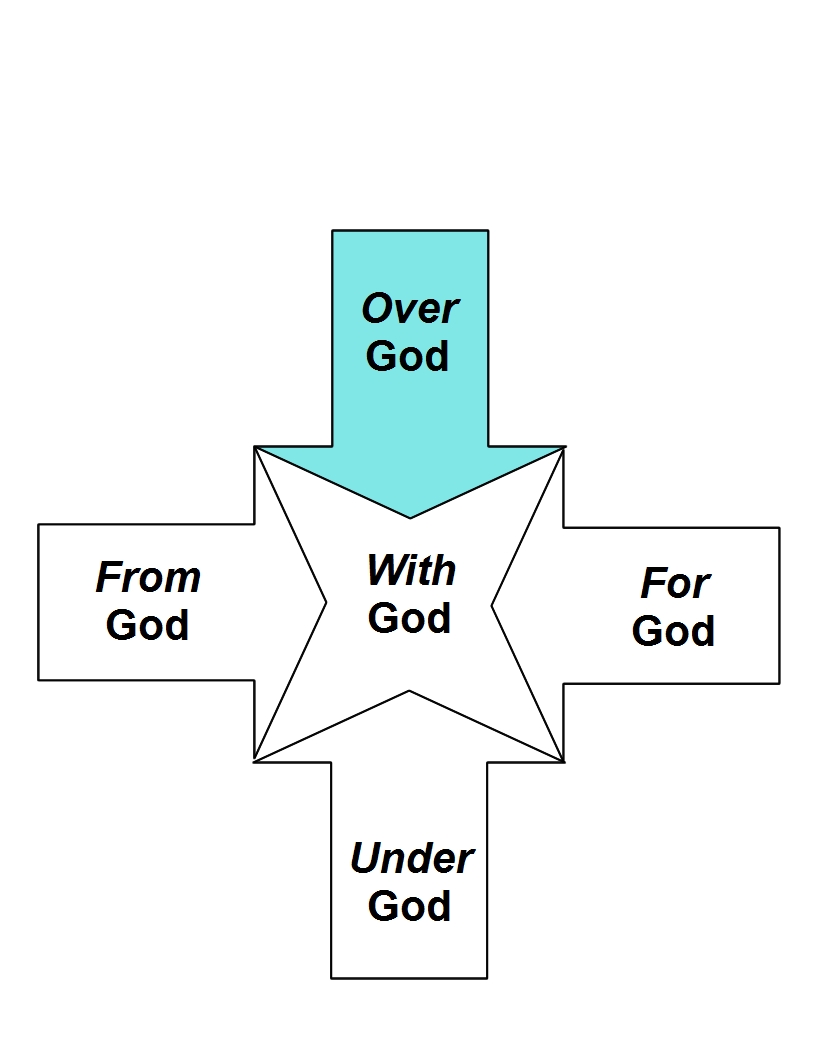
Life OVER God

This is the second of five sermons I’m delivering based on the insights I’ve gained from reading Sky Jethani’s book WITH, Reimaging The Way You Relate to God.

Life WITH God
Part 2
Will God’s Principles Work for Me? Life OVER God
Based on John 5:39-47 and Selected Texts
Inspired by (and with credit to) the book With by Skye Jethani
Delivered on November 10 & 11, 2012

I want to tell you a very short story. Jesus told very short stories; they’re called parables. Here’s a modern-day parable that I’ve written for this sermon. I’ve titled it The Father’s Notebooks.

_______________________________
A Story

Jason’s heart pounded as his aunt explained over the phone what had happened. She had e-mailed him a week earlier that she had found two notebooks that had belonged to his late father, and she said that she’d send them to Jason. His mother had died when he was a teenager, and now his father had recently passed away. In the e-mail his aunt had told him that one notebook contained detailed information about how his father was going to restore the 1948 Hudson car that he had been keeping in his garage all during Jason’s growing-up years. Now, after his dad’s passing, the car was in Jason’s garage and he was planning to carry out the restoration. His father’s notes would be invaluable.

The other notebook, his aunt had written, was a journal that his dad had kept, unbeknownst to Jason. She wrote that she had only flipped through its pages and then closed it when she realized that it was very personal. It was a journal that his father had kept since Jason was born, and it was filled with entries addressed to Jason about his father’s feelings concerning life in general, his reflections on his growing son, and his hopes and dreams for him.

Now his aunt had just informed him that one of the journals had been destroyed by her large St. Bernard dog; he had chewed it to shreds. Then there was silence on her end of the phone. She had an annoying habit — Jason had been aware of it all of his growing-up years — of telling you only part of a story or giving you just a bit of information, then waiting for you to ask her to tell you more. Not surprisingly, she was doing that now: waiting for him to ask her for more details.

“So which of the two journals do you still have?” Jason asked, holding his breath and hoping she’d tell him what he so badly wanted to hear.

“The journal about how to fix up the car was the one Brutus ate. Your dad’s journal written about you and for you is safe. I sent it to you by registered mail this morning.”

Jason breathed a huge sigh of relief. It was relief that he could never in a thousand years have put into words.

___________________________________

Is the Bible God’s notebook, packed with spiritual principles by which you and I are supposed to live? Or is the Bible God’s personal journal to you and me? It’s actually both, but In our faith do we focus primarily on the divine principles or on the Divine Person?

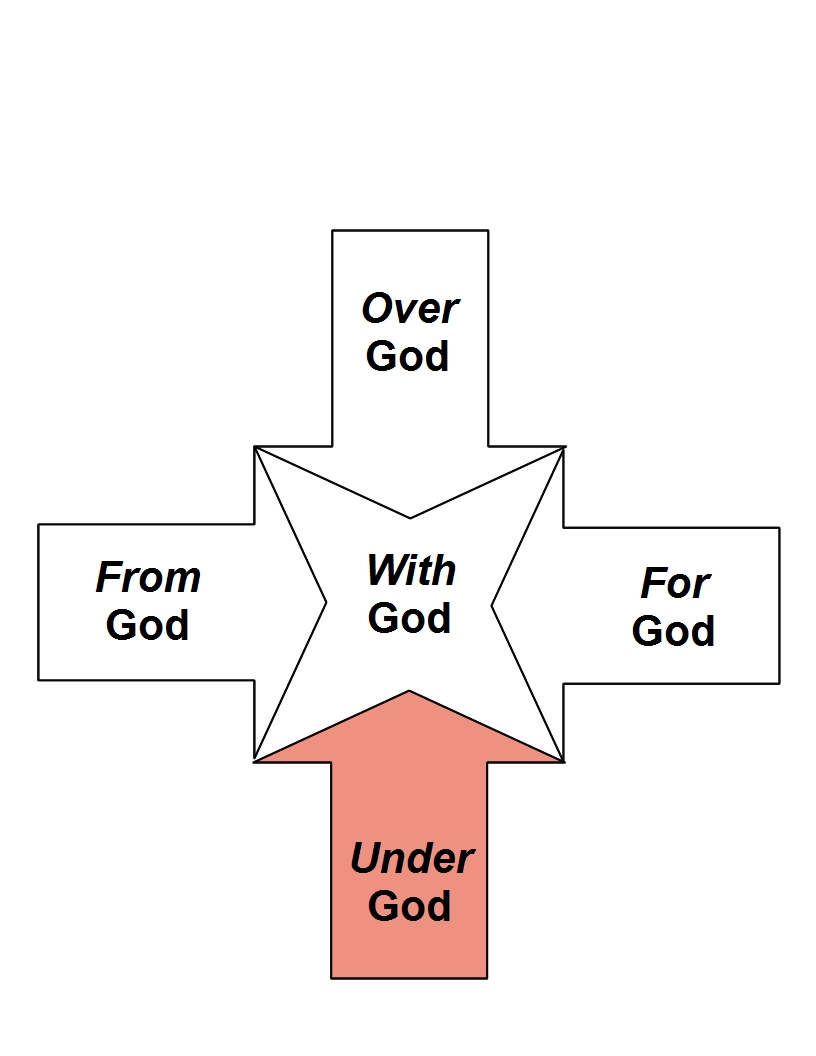
Author Skye Jethani calls a faith primarily focused on following God’s principles life OVER God. Jethani uses five words to help us understand the ways we can relate to God: UNDER, OVER, FROM, FOR, and WITH. Again, I want to credit Skye Jethani for the basic premise of this message and for this entire series of five messages, ideas found in his book With: Reimaging the Way You Relate to God.

God, the Divine Watchmaker

Jethani points out that a popular world view sees God as a divine watchmaker. Many people believe that one way or another, God created everything that there is. However, they also believe that He got it going and that now it pretty well runs on its own. It’s sort of like a watchmaker who makes a watch, winds it, and that’s the end of his involvement with what he created.

Many people who don’t see themselves as strongly religious believe that God has principles for living and that it’s best to live by those laws. They believe in an inherent right and wrong and think that people ought to live accordingly. Moral laws are seen to be like natural laws such as gravity. Life goes best if you respect those life principles, such as loving your neighbor, etc. Many people would agree that God wants us to abide by those laws, but little thought or effort is put into connecting with the One who made the laws. They see God as a distant, disconnected deity. This is “life OVER God,” as Jethani puts it. They see the value of God’s principles, but they don’t seek to know God personally.

However, it’s not just other people who can live “life OVER God,” as Jethani explains it. His point is that we, too — those of us who are Christians, who claim to be followers of Jesus — can be living OVER God instead of WITH God.

Life OVER God

I’ve often referred to the Bible as God’s instruction manual for life. Though there’s an element of truth to that, it’s not the best description of God’s Word. It’s more than a set of instructions — a list of dos and don’ts — for living.

It’s more like God’s journal in which He’s had written what He’s done, what He’s doing, and what He’s going to do as He involves Himself in human history and in our lives. It’s a journal in which God reveals His heart, where He communicates passionately about His love for us and His desire for us to be His and to be with Him now and forever. It’s a father’s journal to His children: to us!

Jethani writes that “When the Bible is primarily seen as a depository of divine principles for life, it fundamentally changes the way we engage God and His Word. Rather than a vehicle for knowing God and fostering our communion with Him, we search the Scriptures for applicable principles that we may employ to control our world and life.” (eBook loc. 730) We can actually practice Christian principles when it comes to family, friends, finances, and fun without Christ’s being a part of the mix. It can mean that we really have a self-centered faith, looking for ways for our lives to work better, rather than a Christ-centered faith. We have a faith of principles for our own benefit instead of personalizing our faith with God.

Again, Jethani writes, “The life OVER God posture’s emphasis on working principles may be appealing because it is far more predictable and manageable than an actual relationship with God. Relationships, whether human or divine, are messy, time-consuming, and often uncontrollable. But principles are comprehensible and clinical.” (eBook, loc. 771)

We can seek to live by God’s principles without getting close to Him, and there’s something in our fallen nature that seems to like that. We’re smart enough and have enough faith in God to know that we have to take Him seriously, and we think that the biggest part of that is living by His principles. However, that’s wrong! God wants more than our obedience: He wants us!

We keep sliding into the posture of being obedient to God without wanting to get close to Him. Parents will bring their children to church in order to get a solid moral grounding, so that they can grow up to be good people. Married couples may be looking for ideas and ways to help out their marriages. Pastors may go to church conferences so they can learn principles on how to build a great church. Struggling people can go to church to learn coping skills for getting through another tough week. All the while we’re afraid to get close to God! We miss most of what God has for us: a close and personal relationship with Him.

Moving Beyond the Principles of God to the Person of God

One time Jesus was talking with His religious critics, who were fellow Jews. We sometimes marvel that they didn’t realize who Jesus was when they were supposed to know the Holy Scriptures so well, but many of them didn’t see Jesus for who He was, and they missed being in a relationship with Him forever. This is what Jesus said was their problem — and it can be ours, too, when we emphasize the principles of Christ instead of the person of Christ: “You diligently study the Scriptures because you think that by them you possess eternal life. These are the Scriptures that testify about me, yet you refuse to come to me to have life.” (John 5:39-40) Note what bothered Jesus most about those religious people who knew the Scriptures so well and tried to live by biblical principles: “. . . yet you refuse to come to me . . . .”

We too can study God’s Word and learn its history and its principles but miss the One whom it’s all about. We can miss the very personal message that the desire of the Lord’s heart is to have a relationship with us, and for us to be with Him.

Once some parents brought their children to Jesus so that they could meet Jesus and He could hold them and bless them. Jesus’ disciples thought that Jesus didn’t have time for children, but Jesus reprimanded them. The Biblical text states, “But Jesus called the children to him and said, ‘Let the little children come to me, and do not hinder them, . . .’” (Luke 18:16) We love the way artists portray that scene, with children on Jesus’ lap and settled at His feet, enjoying Jesus’ attention. Those children weren’t interested in learning any principles from Jesus; they just enjoyed being with Him!

The principles of God’s Word are important, but a relationship with Him is the most important thing. Following His principles can and should be a result of our following Him and being with Him!

Jethani writes that “We may reduce the Bible from God’s revelation of Himself to merely a revelation of divine principles of life.” (eBook loc. 736) The Heavenly Father’s holy book — His Holy Bible — is more than a notebook of His historical activities and His instructions and principles. It’s a journal to us, His children, that reveals the heart of the Heavenly Father! He doesn’t want us to live from a position of life OVER Him, where we simply stand on the principles of His Word for our personal benefit but resist coming to Him personally. He wants us to live from a position of life WITH Him!

Life UNDER God

This is the first of five sermons I’m delivering based on the insights I’ve gained from reading Sky Jethani’s book WITH, Reimaging The Way You Relate to God.

Jethani’s book has really impacted my life and ministry so I thought I’d share the series with you. Again, I give credit to Skye Jethani for the concepts in this series and recommend his book.

Life WITH God
Part 1
Does God Like Me? Life UNDER God
Based on Matthew 11:28-30
Inspired by (and with credit to) the book With by Skye Jethani
Delivered on November 3 & 4, 2012

I prayerfully consider what books to buy and read, for three reasons. First, reading a book will require 20 or more hours of my lifetime. Second, it will undoubtedly have an influence and effect on my life, and I want that to be a positive, God-glorifying effect. Third, because a book will have an effect my life it will have an effect on what I preach, and it will hopefully have an effect on you as you listen to (or read) the message.

A book that has greatly affected my life and walk with God in the last few months has been With, Reimaging the Way You Relate to God, by Skye Jethani. Jethani is the editor of Leadership Journal, a publication of Christianity Today. I read most of the book while I was on my summer study leave at a monastery in Iowa. It was during the heat wave of the summer. As I read the book, sweated, walked and prayed, sweated, read some more of the book, sweated, and walked and prayed, I was being greatly affected by the book’s message.

One marvelous privilege of being your pastor and spiritual leader is that I get to invite you to follow me on my spiritual journey. Ever since I read the book With, Reimaging the Way You Relate to God, I’ve looked forward to sharing what I’ve rediscovered about how to walk with God.

Let me be clear: this sermon series is based on God’s Word, the Bible, and the truth contained therein. However, Jethani’s book brings clarity to a key aspect of God’s Word and His Truth. Therefore, at the outset of this series I express my indebtedness to Jethani and his book in helping me to better understand what life with God is supposed to be like.

If you, like me, have sought to be a follower of Jesus for some time, I believe that you too will gain a fresh grasp on how to follow Jesus in the best possible way. Those of you who are new to the faith, or maybe still exploring and seeking, will find that by grasping the truth of what we’re going to look at, and implementing it, you’ll advance past “GO” in the game of life in Christ and be way ahead in this game of all games.

Our Posture and Position with God

We’re going to affirm that there are wrong ways and a right way to look at our relationship with God. Skye Jethani used five words to help us understand what the Bible reveals about life with God. The five words are what we call prepositions. Here you have to remember a basic lesson from your elementary years in school about what prepositions are: they indicate a relationship or position between two words, ideas, or things. The five words, or prepositions, that we’re going to focus on regarding the way we relate to God are UNDER, OVER, FROM, FOR, and WITH. Prepositions relate one thing in a sentence to something else in a sentence. A preposition specifies a relationship, and Skye Jethani suggests that these five prepositions are positions we can have in relation to God. We’re going to look at life UNDER God, OVER God, FROM God, FOR God, and WITH God.

Again, the first four ways of relating to God are far from the best ways to relate to Him, yet many people use them all the time. We’re going to look at each of these four far-from-ideal ways of relating to God — one way in each message — and conclude with the fifth message focusing on the right way to relate Him: to be WITH God. However, I can’t wait until the last message to give you the proper way to relate to God, so we’ll end each message with a resounding affirmation that of all the positions the best way to relate to God is to be WITH God. Let’s begin by looking at Life UNDER God.

Appeasing the Gods

Our daughter Julie and her family live on a mountainside south of Mexico City, within twenty miles of the volcano Popocatepetl, often called Popo for short. In ancient times the Aztec Indians would make sacrifices near Popo to the volcano gods to appease them. They believed that they were under the control and influence of the gods, so they sought to influence and control the gods by various sacrifices.

Small shrines made in the shape of Popo have been found with crudely-carved human heads on top. The Aztecs would stoke a small fire under these shrines so that they would smoke like Popo. It was their effort to appease the gods and make the gods like them. That sounds silly, but much the same thing was done by people in Jesus’ day.

Life under God’s Yoke

The scribes and Pharisees had studied the Torah — the Law of God, the first five books of our Bible — in great detail. They decided that it contained 613 laws; 248 were positive and 365 were negative. Then they came up with rules and regulations that would keep people from breaking those 613 laws. Those rules and regulations became known as the “tradition of the elders” and were considered to be as much the laws of God as the laws themselves. This, of course, was a real burden for anyone to bear. It was like a yoke that beasts of burden wore when pulling a heavy load. It was how they kept God happy and pleased with them. Of course they never knew when they had done enough to keep on the good side of God and to keep His blessings coming.

That’s life UNDER God, living under His control and trying to keep Him happy. It’s not just the Aztec Indians around Popo or the scribes and Pharisees of Jesus’ time who did that. We fall into the trap of living UNDER God today. What’s a common response that we make when things go wrong? We often ask, presumably addressing the question to God Himself, “What did I do to deserve this?” When things go wrong we can easily believe that we’re being punished by God because He’s mad at us. When things are going reasonably well, we think that God must be pleased with us because He’s blessing us.

However. that doesn’t always seem to add up. For example, parents might really try their best to raise their children in the ways of the Lord, but one or more of the children rebel. The parents may have claimed the verse that states, “Train up a child in the way he should go: and when he is old, he will not depart from it.” (Proverbs 22:6) However, one needs to remember that that verse is found in the Bible in the book of Proverbs. It’s a proverb, which means that it’s a summary of something that more often than not is true. It’s a proverb, not a promise. Raising a child right doesn’t guarantee that they’ll turn out right.

I’ve seen a number of cases where soon after a person turns his life over to Christ he’s hit with a serious health issue. Sometimes the illness leads to much suffering and even death.

A young person takes a vow before the Lord to remain sexually pure until marriage, and does that, but their mate, because of a previous lifestyle contrary to the Lord’s will, gives a sexually transmitted disease to the innocent mate.

Just because we seek to serve the Lord and please Him, it doesn’t guarantee that life will turn out the way we’d like. We can try to live by the rules of God or perform rituals for God – rituals such as worship, Communion, Bible reading, and prayer – in order to manipulate God into doing our bidding. Trying to appease and control God by following rules and rituals is similar to trying to control a radio-controlled toy with the two joysticks on the transmitter unit. We think that we can get joy by controlling the joysticks of rules and rituals. The reality is that God doesn’t play by such rules!

The result in some cases is deep and profound disappointment and disillusionment with God. Well-known pastor Matt Chandler, according to Skye Jethani, gives that as a major reason for youth being “de-churched.” Youth see the promises being made by Sunday school teachers, pastors, and parents that if you abide by God’s standards life will be good. Sometimes it’s not good, and the youth don’t know what they should believe — so they stop believing.

Even if we don’t stop believing, if we live with this performance-based relationship with God we’re always going to wonder whether we’re doing enough to please Him. When things go bad, we often doubt that we’re doing enough. Such a faith results in fear that we’re not pleasing God — or appeasing Him — enough. Then there’s no place for God’s grace in our relationship with Him — and His grace is what it’s all about.

Getting Out from Under Life with God

Let’s go back to the religious leaders of Jesus’ day who carried, and asked others to carry, the heavy burden, or yoke, of trying to please God. Jesus said — and this is amazing — “Come to me, all you who are weary and burdened, and I will give you rest. Take my yoke upon you and learn from me, for I am gentle and humble in heart, and you will find rest for your souls. For my yoke is easy and my burden is light.” (Matthew 11:28-30)

Jesus was saying that instead of focusing on burdensome rules and rituals — a heavy yoke indeed — we should take upon ourselves the burden of being with Him, in His yoke with Him, because He’s gentle and humble. We’ll find it restful, because His yoke is easy and light! Jesus invites us to be with Him in His yoke: WITH Him! Jesus’ call to us is always and foremost a call to be with Him! It’s a relationship, a closeness, an intimacy.

Does that mean that rules (seeking to do what’s right and good and godly) and rituals (such as worshiping, reading the Bible, and praying) aren’t important? Not at all. They’re very important, but we shouldn’t do them so that God will accept us; we should do them because we’ve responded to His love, grace, and mercy. We do them because He does accept us! We seek to please Him because He has already extended to us His love, grace, and forgiveness! Our response of living for Him isn’t a duty; it’s a delight!

When we follow Jesus we aren’t guaranteed that everything that happens to us will be good. However, we’re always guaranteed the joy that comes from being with Jesus, no matter what’s happening!

We aren’t called to live under the burden of trying to appease God and manipulate Him so that we can get good things. God is the good thing! Give up the burden of trying to live UNDER God, and accept the blessing of living WITH God!

My “Spinning Wheels”

Mahatma Gandhi, a religious as well as political leader in India, was not a Christian, but there are lessons his life can teach those of us who are Christian leaders, those of us who are pastors. One such lesson is from Gandhi’s use of the spinning wheel.

Gandhi’s spinning wheel was a tangible way for him to communicate to the people of India the importance of freeing themselves from economic dependence on the British. If they would spin their own cotton they could make their own clothes and not depend on purchasing clothing from Britain.

But apparently Gandhi also came to see the emotional and spiritual benefits of his use of the spinning wheel.  He said that it helped with “the education of becoming and being.”

Eliza Drummond wrote in Spinners Quarterly, July 2004, of the value of using the spinning wheel in prayer and meditation. “In order to find out more about why we spin, I sent out 400 questionnaires to 80 spinning guilds across the United States and Canada. In these questionnaires I asked introductory questions such as ‘how long have you been spinning?’ and ‘how often do you spin?’ I also posed questions such as ‘have you ever thought that spinning is meditative?’ and ‘do you ever spin for the purpose of praying or meditating?’ Seventy-five percent of respondents answered that they consider spinning to be meditative, and 40% answered that they actively spin to meditate or pray. Of the latter group, all of them find it effective as a form of meditation and prayer.”

I don’t have a spinning wheel, but I do have other ways of spending my time that replenish my soul. Yes, of course, there’s the time I spend in my daily devotions of Bible reading, other spiritual reading, and prayer. This is top on my list. But I have other less “spiritual” activities and hobbies that help me keep my balance as I face the rigors of ministry.

Photography is a serious hobby for me. When I am about the business of lining up a good photograph the time seems to either stand still or fly by, I’m not sure which.  Writing is a big part of my time away from pastoral ministry.  I’ve written both non-fiction and fiction, including a couple of novels.  I also raise a small flock of chickens as a hobby, and have done so for over a quarter of a century. Then too I have a decorative pond with waterfall, fish, and floating pond plants that I maintain.

These are my “spinning wheels” that help keep me sane in ministry. Such interests keep me from putting all my emotional eggs in the basket of pastoral ministry (sorry, after all these years of raising chickens I can’t resist a poultry analogy).

The apostle Paul was a tent maker. This was probably out of economic necessity more than anything else, but I can’t help but wonder if he didn’t also appreciate the break from his usual apostolic duties. I’m sure Paul did a lot of talking, listening, praying, and even mentoring while working on tents, but there must still have been something therapeutic about using his hands.

If I could give some advice to those going into ministry I would strongly suggest that they hold on to or adopt some other interest or outlet other than pastoral ministry to which they could give their time and attention on a regular basis, a “spinning wheel” to which they could go regularly for a change of pace. My “spinning wheels” have be instrumental in my longevity as a pastor and as a pastor in one place. They have been used of the Lord in my life to keep me at the task of serving His people as their pastor.

How about you? What are the “spinning wheels” in your life? Please, share with the rest of us.

A Prayer I Often Pray

I came up with this prayer a few months ago.

It seems I find myself repeating it quite frequently!

Feel free to pass it along.

Rejoicing With the More Fortunate

“The love for the less fortunate is a beautiful thing – the love for those who suffer, for those who are poor, the sick, the failures, the unlovely. This is compassion, and it touches the heart of the world. The love for the more fortunate is a rare thing – to love those who succeed where we fail, to rejoice without envy with those who rejoice…” (Frederick Buechner in The Magnificent Defeat, as quoted by Francis Chan in Crazy Love, p. 132)

The love for the more fortunate is a rare thing…”

Ouch! I must confess there have been times when I’ve heard of the success of another pastor and I have not rejoiced. Why couldn’t I celebrate the news that the Kingdom of God had advanced through another pastor? This is a terrible thing! An honest appraisal of my lack of rejoicing exposes the presence of envy, even jealousy. The apostle Paul encouraged his Roman readers to “rejoice with those who rejoice; mourn with those who mourn.” (Romans 12:15) I find it much easier to comply with the second half of that challenge than the first half! I can feel sorry for a pastor who’s struggling, but to be happy for a pastor who’s seeing success is often another matter.

Plotting my own perceived position among others who pastor can become the objective rather than advancing God’s kingdom through the people I pastor. We’re supposed to be in this together! How dark the soul! It’s a reminder of my constant need of the grace and mercy of the Christ I follow and proclaim.

A Passion for Pastoring

The other night Diann and I watched one of the few TV shows we enjoy, Undercover Boss. The premise of the show is for the boss of a company to go undercover in his own company, disguised as a new hire. The explanation for the camera following him around is that it’s being taped for a reality show. The boss usually gains some new insights into the company and those who work for the company.  The conclusion of the show has the boss revealing his true identity and rewarding those with whom he worked while undercover who are doing a great job.

Last week’s show was about the boss of Rally’s and Checkers Hamburgers, Rick Silva. It was amazing to see how passionate he is about hamburgers! He was bubbling over with enthusiasm, describing how he wants to produce the best burger and the best service in the business. He’s intolerant of producing just average burgers and fries and of mediocre performance by his workers.

Rick Silva convicted me! If he’s so passionate about producing hamburgers, then how much more should I be passionate about leading a local franchise of the Kingdom of God where our task is to produce and grow disciples for Jesus! We as pastors are entrusted with delivering the best “product” in the world, the Gospel.  What could be more motivating?  Ouch!

The apostle Paul wrote to the young pastor Timothy, “Do your best to present yourself to God as one approved, a workman who does not need to be ashamed and who correctly handles the word of truth.” (2 Timothy 2:15)  Yes, Paul, I need your words too!

As a local franchisee for the Kingdom of God I want to remember that my CEO is always “undercover” in my local franchise of His kingdom. Yes, His presence should be a sobering reminder for me to do my best, but also a great comfort and help knowing that He’s there to help me make happen what He wants to see done.

He’s given me a franchise to serve. I want to have the passion to see it thrive!  You too?

Being a Teachable Teacher

My Feet, His Arms

I’m reading a new book on my Kindle. Found this quote helpful to my soul.

“Come then…let us be resigned to our frailty and dependence on God, who would never reduce us to being unable to walk on our own feet if he had not the mercy to carry us in his arms.”

The Contented Soul by Lisa Graham McMinn

An Old Prayer for Today

Here’s a portion of a prayer from The Life of God in the Soul of Man by Henry Scougal. Scougal was born in 1650, exactly 300 years before me! I came across him when reading John Piper, who wrote that Scougal had a profound influence on him. I ordered Scougal’s book (you’d never find it on the shelf at a local bookstore). Come to find out Susanna Wesley was highly influenced by Scougal and commended him to her two sons. Whitefield also was impacted by him. And to think I had never heard of him. OK, so here’s the portion of a prayer of his I promised.

“O God, grant that the consideration of what thou art, and what we ourselves are, may both humble and lay us low before thee and also stir up in us the strongest and most ardent aspirations towards thee! We desire to resign and give up ourselves to the conduct of thy Holy Spirit… Amen” (p. 95)

The Right Preposition for Pastors, and Everyone Else Too

Christianity Today magazine recently listed the best books for the leader’s inner life. With, Reimaging the Way You Relate to God by Skye Jethani was on that short list. I read a majority of the book while on a three day study leave at a Trappist monastery in Iowa. What a great book with which to have retreated! It’s at the top of my list of books that have impacted my walk with Christ and my ministry. Jethani creatively uses five prepositions to explain the different ways we position ourselves with God, four that aren’t good as the ultimate positions from which to relate to God and one that is.

In one place Jethani summarizes by stating that “…when God desired to restore his broken relationship with people, he sent his Son to dwell with us. His plan to restore his creation was not to send a list of rules and rituals to follow (LIFE UNDER GOD), nor was it the implementation of useful principles (LIFE OVER GOD). He did not send a genie to grant us our desires (LIFE FROM GOD), nor did he give us a task to accomplish (LIFE FOR GOD). Instead God himself came to be with us – to walk with us once again as he had done in Eden in the beginning.” (1402, location in e-book)

As Jethani explains it LIFE UNDER GOD is when I fear I’ve not been good enough or done well enough to be the recipient of God’s blessings, either for myself or for my church. I’m always wondering if I’m measuring up, and I never do. If, for some strange reason, I think I’m doing quite well with God, then I begin to believe God owes me, and I’m disappointed or angry when God doesn’t bless as I think He should.

I see myself living LIFE OVER GOD when I believe that if I do things right that God will bless. If I lead my church toward being a church that exhibits the Biblical church growth principles of a what church should be then I can expect it to be a growing and thriving church, guaranteed! I use His Word as a manual on how to do things right.

When I’m living from the perspective of LIFE FROM GOD I’m operating under the assumption that if I just have enough faith then God will bless the way I imagine He should. If I believe that God is really a big God then I’m going to see really big results, every time.

LIFE FOR GOD is the perspective, I believe, that sincere disciples of Jesus focus on most, including sincere pastors. We want to serve God, to carry out His purposes for us. Obedience is good, but it easily becomes something of a duty, even a drudgery.

All of these four perspectives have some elements of truth to them, they just make for a lousy ultimate perspective. Our ultimate perspective is to be LIFE WITH GOD. The goals of the other perspectives are to, in some way, use God, that God is a means to an end. LIFE WITH GOD makes God Himself the goal!

It’s painful for me to reflect on how frequently I’ve focused on the four less-than-ideal positions in my own walk with Christ and how often I’ve sought to move my parishoners into one or more of these positions. I’ve renewed my commitment to have a LIFE WITH GOD. Everything else falls into its proper place when I live from this perspective.

If I could recommend one book I’ve read in the last couple of years this would be it. More than anything else, more than any other perspective from which I could live, I want to live a LIFE WITH GOD! Jethani’s book reminded me of that.